Since I’ve been blessed with the
dubious gift of easily memorizing random and often useless data, I never had
any trouble ingratiating myself with my geography teachers, who would let out
the occasional satisfied sigh as I soldiered through the copper mines of
central Romania, the capitals of lesser known states of Oceania or the many
many headwaters of the Amazon river. In
the long run, the only actual benefit that I am aware of is that I used to
score extremely highly at all sorts of obscure geography quizzes which proliferated
on Facebook a few years ago.
And, perhaps, a fascination with
the karstic landscape. The karst was a big favourite with our elementary school
geography teacher, who would spend endless, and to most of my colleagues,
excruciatingly boring hours delving into the many manifestations of the karst.
I was however smitten- in the arid world of altitudes and longitudes, the karst
was a fairy tale with magic spells such as polje, dolina or ponor. (That might also be the beginning of my love for Slavic languages, but that is another story altogether.)
I was therefore somewhat
comforted to find that the karst is very much real, and not very distant- the
name of these formations comes from the Karst limestone plateau sprawling over
the border of Slovenia and Italy. However, the internationally used
denomination is the German one (the plateau is known as Carso in Italian and Kras
in Slovenian) due either to the fact that when the karst started to be studied
the territory belonged to the Habsburg Empire or just because science is simply
more authoritative in German.
While a lot of karstic formations
might not be overly inspiring to the uninitiated, the superstars of the landscape
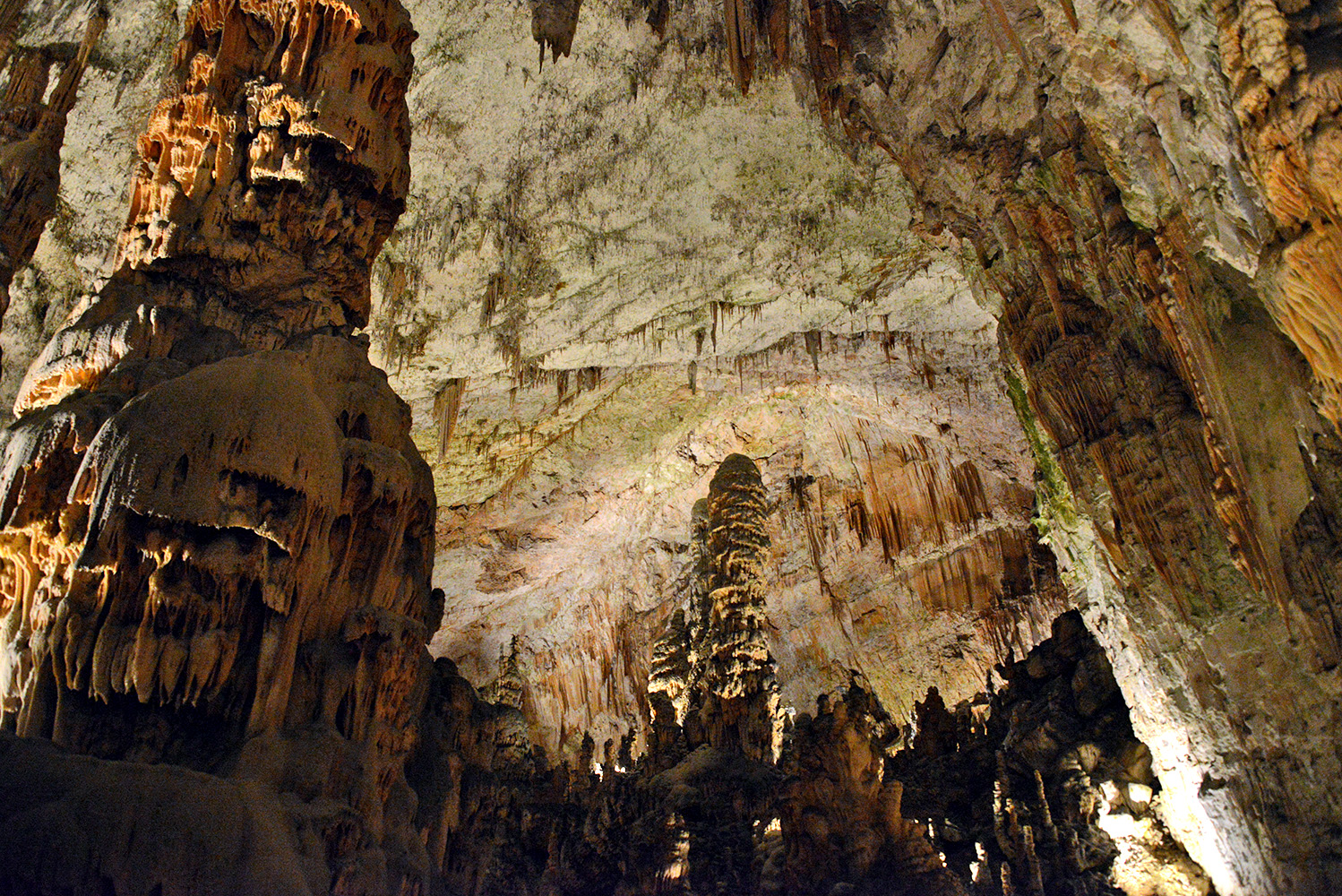
are the caves, with the Postojna cave system, measuring 24,120 metres,
taking the palm. These days the cave functions as a clockwork perfect system of
touristic entertainment: after a rather severe looking cashier hands you the
ticket, you are ushered through a complex system of restaurants and souvenir
shops to the entry of the caves, where tours start sharp on the hour. Once
released from the dark underbelly of the earth, you may indulge in the
pleasures of a decidedly canteen-ish restaurant- but strictly between 12 and 3,
those lacking in discipline are left to chewing nuts and biscuits amongst the stalactites.
The efficiency is hardly
surprising- the caves were a touristic attraction from the 19th
century, with rails being laid in 1872, electricity being introduced in 1884
and several VIPs of the era, among them Emperor Francis I and Archduke
Ferdinand, being given the grand tour of the premises. Today the tour lasts an
hour and a half, with about 1.5 kilometres done on foot, and another 3.5 by
train. Guides speaking several languages are provided for each group, lest some
inquisitive visitor potter away into the eternal darkness. Besides admiring the
eerie landscape, one can also get acquainted with the so called human fish, though
they are actually salamanders whose official name is olm or proteus. The human
fish moniker was given to them due to their white skin, similar to that of
Caucasian humans, a result of their prolongued inhabitation of lightless
places.
The village of Postojna is only a
short drive away from Slovenia’s capital, Ljubljana, which is a pretty
understated affair compared to other European capitals and also suffers from
the proximity of so many tantalizing attractions- it’s therefore safe to say
that most people visiting the country will add the city to their tour as a side
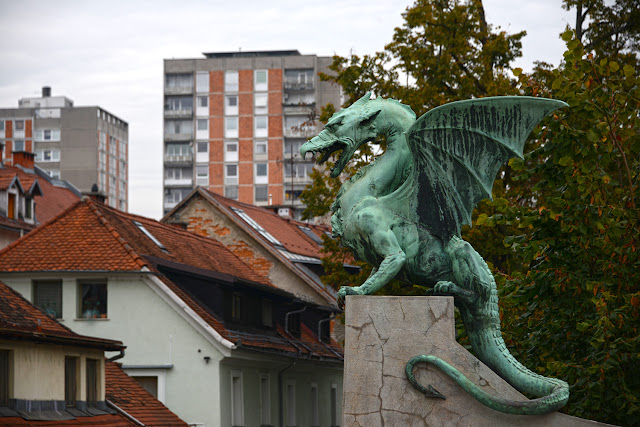
note. Which is a pity, because in Ljubljana be dragons- not particularly large
or fierce ones, but dragons nevertheless.
How the city got its dragons is a
slightly contentious subject: one pretty convoluted legend has it that Jason
and the Argonauts slayed a mythical creature in the marshes around present day
Ljubljana during their quest for the Golden Fleece, while more down to earth
versions connect the dragon to Saint George, the patron of the citadel’s
chapel. Be it as it may, the city centre now sports a dragon bridge arching
over the waters of the Ljubljanica, which, alongside a handful of other notable
buildings and churches forms the scenic core of Slovenia’s capital. Prešeren Square sports a pleasantly
candy pink cathedral and the Art Nouveau building of Galerija Emporium, where
you can satisfy your possible high end retail therapy needs, though I
personally prefer simply staring at the entrance, because it’s a thing of
beauty and costs considerably less than some designer bag in which you can
hardly squeeze a lipstick and half your phone.
Secession fiends have their needs
catered to by Miklošičeva street, which sets off straight from the Emporium
building, while roaming around the banks of the Ljubljanica you will often meet
the works of the country’s most famous architect, Jože Plečnik, such as the
Fish Market or the Cobblers’ and the Triple bridges. The river side is also
dotted with cafés, which had a decidedly outdoorsy Mediterranean vibe even on a
rainy October evening while Stari Trg, connecting the centre to the castle, has
several exciting shops of which we will naturally highlight the beer store, Za popen't, where one can purchase a varied array of local craft beers- on a touching note,
they qualify as local everything coming from the space of the former
Yugoslavia.
Most travelers have probably
encountered castles far more exciting than the one in Ljubljana, but yet again
one has to be impressed by the marketing flair of Slovenians: every bit of the building
is nicely touched up and used for some purpose, even if it’s an odd exhibition
or a Puppet Museum- though, frankly, the Puppet Museum is far more interesting
than initially thought and I would warmly recommend it to anyone- bar perhaps
some of the scarier dolls. According to our informative booklet (Slovenians
also love those and have them ready in several languages at most touristic
attractions), on a clear day you can see about a third of Slovenia from the
castle’s tower. However, our day happened to be a rainy and foggy one, which
was only half a pity, because there’s an unexpected charm in mist rolling over
the yellow and crimson hills embracing autumnal Ljubljana and that’s somehow
befitting the entire city as well- you start liking it when you least expect
it.